
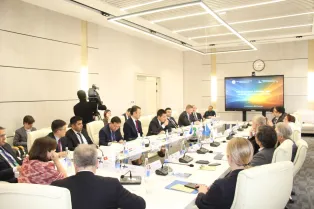
Within the framework of the MOCCA (Multilevel Orders of Corruption in Central Asia) and MARS (Non-Western Migration Regimes in a Global Perspective) projects, project team members from Lund University participated in the First “Central Asia – Nordics” Think Tank Forum held at the International Institute for Central Asia (IICA) in Tashkent. The delegation included Dr Rustamjon Urinboyev, Principal Investigator of the MOCCA and MARS projects and Associate Professor at the Department of Sociology of Law, Lund University; Dr Sherzod Eraliev, Principal Investigator of the MARS project and Senior Researcher at the Sociology of Law Department, Lund University; and Dr Patrik Olsson, Senior Lecturer at the Sociology of Law Department, Lund University.

The historic forum brought together analytical centers, experts, diplomats, government representatives, and the business community from Central Asian countries (Kazakhstan, Kyrgyzstan, Tajikistan, Turkmenistan, and Uzbekistan) and the Nordic Council member states (Denmark, Finland, Iceland, Norway, and Sweden). The event aimed to strengthen cooperation between the two regions and facilitate knowledge exchange in crucial areas including sustainable development, green energy, strategic raw materials, education, human capital development, digitalization, and effective governance.
Panel sessions highlighted the Nordic countries' integration model as a successful example of regional cooperation that preserves national sovereignty while implementing joint programs in labor markets, passport unions, energy, ecology, and culture. Experts emphasized that the Nordic approach to education and human capital development holds particular significance for Central Asia, as Finland, Sweden, and Denmark rank among global leaders in educational quality and innovation. Academic exchanges, research programs, and STEM initiatives were identified as potential pathways to support reforms and youth development across Central Asian states.
Representatives highlighted that Central Asia plays an important role in global processes and that the region's experiences can serve as valuable models for other regions. The forum addressed contemporary challenges in education, business, and investment, with participants expressing confidence that sustained dialogue in such formats will enable the gradual development of long-term solutions to shared challenges.

EU-Funded Projects Enabling Regional Cooperation
The MOCCA and MARS projects, coordinated by Lund University's Department of Sociology of Law, represent flagship EU-funded research initiatives that enable academic cooperation and knowledge exchange within the "Central Asia – Nordics" format, serving as vital conduits for transferring experiences between these two regions.
Through systematic research exchanges, capacity-building activities, and collaborative research initiatives, MOCCA and MARS project teams contribute foundational expertise that proves essential for emerging regional cooperation frameworks. The participation of the MOCCA and MARS project team and their networks in the First “Central Asia – Nordics” Think Tank Forum demonstrates the projects' fundamental role in building the future capacity of think tank forums in this format.
Knowledge Transfer in Practice
The forum exemplifies how EU-funded research projects yield tangible results through the fruitful transfer of knowledge and its practical application in the policies of Central Asian countries. By facilitating dialogue between Nordic and Central Asian experts, researchers, and policymakers, these projects create platforms where evidence-based policy recommendations can be developed and disseminated. The systematic engagement of MOCCA and MARS researchers in regional forums ensures that comparative research findings on governance, anti-corruption measures, and migration management inform policy discussions and institutional reforms across Central Asia.
The establishment of the Think Tank Forum in the “Central Asia – Nordics” format represents a significant milestone in interregional expert dialogue. As this format continues to develop, EU-funded academic projects such as MOCCA and MARS will remain instrumental in sustaining knowledge networks, providing empirical research foundations, and translating scholarly insights into actionable policy recommendations that address the governance challenges facing both regions.
The forum concluded with commitments to continue this dialogue format, positioning it as a regular platform for strengthening strategic partnerships and promoting shared prosperity through evidence-based cooperation in sustainable development, innovation, and institutional reform.